
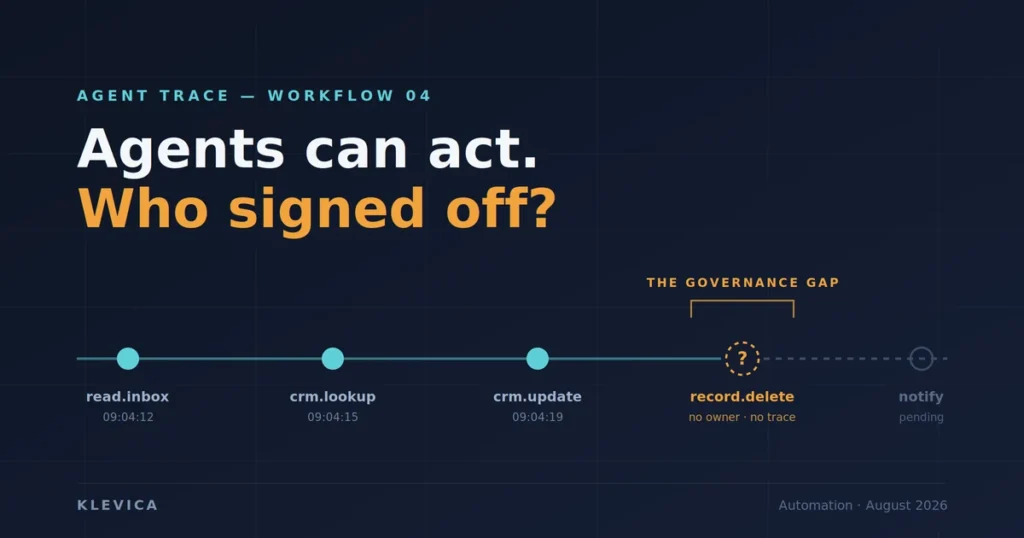
Automation stopped being a pilot project this year. Agents are reading inboxes, updating CRM records, provisioning accounts and pushing code in live environments across enterprise software, logistics, finance and healthcare.
The interesting shift is what teams are now arguing about internally. A year ago the question was whether an agent could reliably complete a multi-step task. That question is mostly settled. The question in August 2026 is narrower and much less exciting: when the agent does something wrong, who owns it, and can you reconstruct why it happened?
Most organisations cannot answer that yet. It has quietly become the real ceiling on automation.
The capability gap closed faster than the accountability gap
Two things happened at once this year.
Model and runtime capability improved sharply. Long-running agent harnesses matured to the point where a single session can manage sustained multi-step work with real tool access rather than one-shot prompt-and-response. Enterprise vendors shipped frameworks for orchestrating specialist agents — one that triages email, one that writes to the CRM, one that escalates exceptions — without requiring an ML team to build the plumbing. The Model Context Protocol has moved toward standardisation, which means the connection between an agent and your production systems is becoming a commodity rather than a bespoke integration.
Meanwhile, controls stayed roughly where they were in 2024. Agents were bolted onto existing identity systems, existing service accounts, existing logging. That works fine until an agent deletes the wrong record, emails the wrong customer, or misclassifies a document in a regulated process — and the only artefact you have is a line in an application log saying an API call succeeded.
Google Cloud’s own guidance this month makes the same point from the platform side: agent security is now the gating issue for scaling autonomous workflows, and the recommended fix is not a better prompt. It is platform-level governance, task-level provenance, and deliberate human-in-the-loop checkpoints.
The funding market has noticed too. Agent security and governance became a first-class category in August rather than a feature request, with nine-figure rounds going into platforms whose entire pitch is watching what agents do.
What “governance” actually means in practice
The word is vague enough to be useless, so here is the concrete version. Four things.
1. Task-level provenance, not application logs. For any agent action that changed state, you should be able to answer: which task triggered this, what did the agent believe at the time, which tools did it call, in what order, and what did each return. This is a trace, not a log line. Teams that retrofit it after an incident always find the crucial step was the one nobody instrumented.
2. Short-lived, scoped permissions. Most agent deployments still run on a long-lived service account with broad access, because that was the fastest path to a working demo. It is also the reason a prompt injection attack turns into a data exfiltration incident rather than a failed tool call. Permissions should be issued per task, expire, and cover only the specific records or endpoints that task needs.
3. A written escalation boundary. Decide explicitly which actions an agent may complete alone and which require a human signature — then encode that in the system rather than in a policy document. The pattern that is emerging in production is narrow: autonomous for high-volume, low-consequence, reversible work; human-in-the-loop for anything involving money, personal data, external communication or deletion.
4. A named owner per workflow. Not “the AI team”. A specific person accountable for a specific automated process, the way a process owner exists for anything else that touches customers. This is the control that most often does not exist, and the absence shows up the moment something breaks.
The part that is genuinely hard
Only the first three are engineering problems. The fourth is organisational, and it is why this gap is not closing on its own.
Prompt injection remains an unsolved research problem — an agent that reads untrusted content can be steered by that content, and no amount of instruction hardening fully removes the risk. That is a good argument for scoped permissions and reversibility, not for waiting. But the deeper issue is that automation projects are usually justified on efficiency, and governance work does not show up in the efficiency number. It shows up as a cost, right up until the incident that it would have prevented.
Regulation is starting to force the issue. Article 50 transparency obligations under the EU AI Act took effect on 2 August 2026, requiring disclosure when users interact with AI and machine-readable marking of AI-generated content in some cases, with penalties scaling to a share of global turnover. If you have EU customers, this is not optional, and audit trails are how you demonstrate compliance rather than assert it.
What to do this quarter
If you are running agents in production, or about to be, three things are worth more than another model upgrade.
Pick your highest-volume automated workflow and try to reconstruct, end to end, what the agent did last Tuesday. Whatever you cannot reconstruct is your instrumentation backlog.
Take one agent off its shared service account and move it to per-task credentials. It will be annoying. It is also the single highest-leverage change available.
Write down, in one page, the actions your agents may take without a human. Circulate it. The disagreements that surface are the useful output.
Capability has stopped being the constraint. The teams that get real leverage from automation over the next year will be the ones who can show their work.