
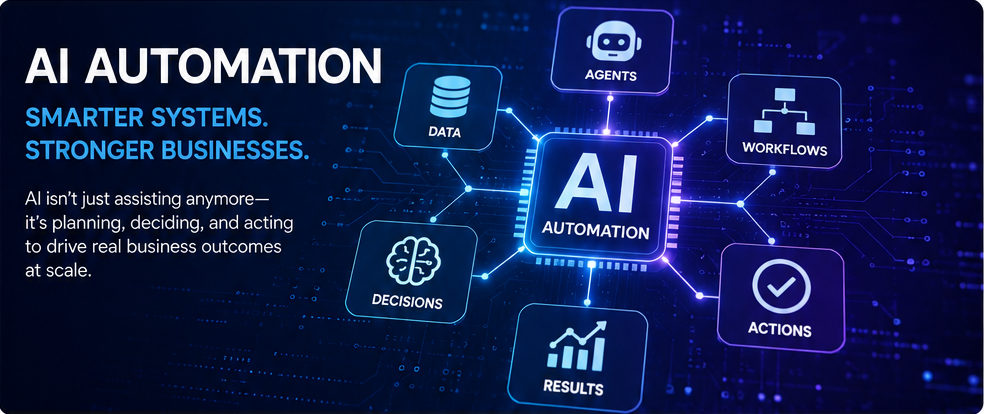
AI automation is entering its next phase. The biggest change in 2026 is not simply that AI models are becoming smarter—it is that AI is increasingly able to take action, use tools, coordinate with other agents, and complete multi-step business workflows.
Businesses are moving beyond asking AI to write an email or summarize a document. The new question is:
What business process can AI run from beginning to end?
That shift is creating a new generation of AI-powered automation across marketing, sales, customer service, finance, IT, operations, and software development.
The Biggest AI Automation Trends in 2026
1. AI Agents Are Moving From Assistants to Operators
Traditional AI assistants wait for a user to provide a prompt.
AI agents are different.
An agent can receive a goal, reason about the steps required, access tools and data, execute actions, evaluate the result, and continue until the task is completed.
For example, instead of asking:
“Create a marketing report.”
a business could give an AI agent a goal:
“Analyze this month’s campaign performance, identify the biggest opportunities, create recommendations, and prepare next month’s campaign.”
The agent can potentially interact with analytics systems, CRM platforms, spreadsheets, email tools and other business applications.
Google’s 2026 AI Agent Trends report highlights this move toward agents that can plan and execute multi-step tasks, while Forrester reports that three-quarters of enterprise leaders say they are adopting agentic AI—even though relatively few organizations have moved beyond early-stage implementations at scale.
2. Multi-Agent Automation Is Becoming the Next Layer
One AI agent can handle a task.
Multiple specialized agents can handle an entire workflow.
Imagine a marketing workflow with:
- Research Agent — discovers relevant industry news
- Analysis Agent — evaluates what matters
- Content Agent — creates the article
- Design Agent — generates supporting visuals
- SEO Agent — optimizes the content
- Distribution Agent — prepares the campaign
- Analytics Agent — monitors performance
Instead of building one enormous AI system, businesses can coordinate specialized agents.
This is one reason multi-agent architectures are becoming an important area of enterprise automation. UiPath’s 2026 automation research identifies the move from standalone agents toward multi-agent systems as a major trend.
3. AI Is Becoming the New Automation Layer
For years, business automation largely followed a predictable model:
Trigger → Rule → Action
For example:
New lead → Add to CRM → Send email
AI automation introduces a more flexible model:
Trigger → Understand context → Decide → Execute → Evaluate → Continue
This makes automation useful for processes that were previously too complicated or variable for traditional rules.
IT automation is already moving toward agentic workflows, automated decision-making and AI-driven pipelines.
The result is a convergence between AI and workflow automation.
AI provides the intelligence.
Automation provides the execution.
Together, they create intelligent business processes.
4. AI Agents Will Connect More Software Together
The value of an AI agent depends heavily on what it can access.
An isolated AI model can generate text.
An AI agent connected to a CRM, database, email platform, calendar, analytics system and internal knowledge base can actually do work.
This is driving demand for standardized ways for AI systems to interact with tools and other agents.
The Model Context Protocol (MCP) and Agent2Agent (A2A) ecosystem are examples of this direction. A2A is specifically designed to allow independent AI agents to communicate with each other, while MCP focuses on connecting AI applications with tools and data.
This could become one of the most important infrastructure layers for AI automation.
5. Context Is Becoming More Important Than the Model
Businesses are learning an important lesson:
A powerful AI model without business context can still produce mediocre results.
The next generation of automation systems will increasingly combine AI models with:
- Company knowledge
- Customer information
- Business rules
- Historical activity
- Industry-specific data
- Internal documentation
- Workflow history
- User preferences
- Real-time information
This is why context engineering is becoming an important enterprise AI concept.
The goal isn’t simply to give AI more information.
The goal is to give it the right information at the right moment.
Recent enterprise research highlights business context as one of the major factors separating useful AI implementations from generic AI experimentation.
6. Human-in-the-Loop Will Become Human-on-the-Loop
Automation does not necessarily mean removing humans.
Instead, the role of humans is changing.
Rather than manually performing every step, employees increasingly:
Set objectives → Monitor AI → Approve important decisions → Handle exceptions
This creates a model where humans supervise automated systems rather than operate every individual task.
For high-risk areas such as finance, healthcare, legal services, cybersecurity and compliance, human oversight remains particularly important.
The emerging enterprise model is therefore not:
Humans OR AI
but:
Humans + AI agents + automation.
7. AI Governance Is Becoming an Automation Problem
More autonomous AI creates a new challenge.
If an AI agent can read data, call APIs, modify records and send messages, organizations need to know:
What is the agent allowed to do?
This makes permissions, identity, monitoring, audit trails and policy enforcement increasingly important.
Governance is moving from documents and periodic reviews toward controls that operate directly inside AI workflows.
UiPath, for example, identifies “governance-as-code” as an emerging requirement for keeping agentic systems secure and compliant.
Security is also becoming more complicated because agents can operate with privileged access across multiple systems.
8. AI Automation Will Become More Cost-Conscious
The first phase of enterprise AI was heavily focused on experimentation.
Now companies are asking harder questions:
What does this automation cost?
How much time does it save?
Does it increase revenue?
Can we run it at scale?
Agentic workflows can require substantially more inference and infrastructure than simple chatbot interactions because agents may perform many model calls and tool operations during one task.
Gartner-related analysis reported in 2026 points toward rapidly increasing infrastructure demand from agentic AI and a growing importance of inference workloads.
This will encourage businesses to use the right model for the right task instead of automatically using the largest model for everything.
9. AI Automation Is Moving Into the Background
Perhaps the most interesting trend is that AI will increasingly become invisible.
Users won’t necessarily open an AI application.
Instead, AI will operate inside existing software.
A sales representative may simply update a CRM.
Behind the scenes, AI could:
- Research the customer
- Identify opportunities
- Prepare follow-up content
- Update records
- Schedule activities
- Analyze previous conversations
- Recommend the next action
The user experiences a better workflow—not necessarily “an AI product.”
This is the beginning of AI-native software, where intelligence becomes part of the operating layer of an application.
What This Means for Businesses
The biggest mistake businesses can make in 2026 is treating AI automation as another chatbot project.
The real opportunity is to identify repetitive, high-value workflows and redesign them around AI.
Start with processes where:
- Employees spend significant time collecting information
- Decisions depend on large amounts of data
- Multiple applications need to work together
- Work requires repeated research or analysis
- Customers expect fast responses
- The process has measurable business outcomes
Then automate one workflow at a time.
For example:
Lead generation → Research → Qualification → CRM update → Personalized outreach → Follow-up → Reporting
That is far more valuable than simply adding a chatbot to a website.
The AI Automation Stack of 2026
A modern AI automation platform increasingly looks like this:
Business Data
↓
Context & Knowledge Layer
↓
AI Models
↓
AI Agents
↓
Tools & APIs
↓
Workflow Orchestration
↓
Governance & Security
↓
Business Outcome
The important shift is that AI is no longer just sitting at the top of the stack generating content.
It is becoming part of the execution layer of the business.
The Bottom Line
AI automation in 2026 is moving from “AI helps employees” toward “AI operates workflows.”
The winners will not necessarily be companies using the biggest AI models.
They will be companies that understand their processes, connect their systems, provide the right context, establish strong controls, and use AI where it can produce measurable results.
The next competitive advantage may not be having an AI assistant.
It may be having an AI-powered business that can execute faster than its competitors.
The Future of Automation Is Already Here
The transition will not happen overnight.
Most businesses will move through several stages:
Manual → Rule-based automation → AI-assisted workflows → AI agents → Multi-agent operations
The companies that begin redesigning their workflows now will have a significant advantage as AI automation becomes a fundamental part of how businesses operate.
The future isn’t simply automated software.
It’s software that can understand, decide, act and continuously improve.